




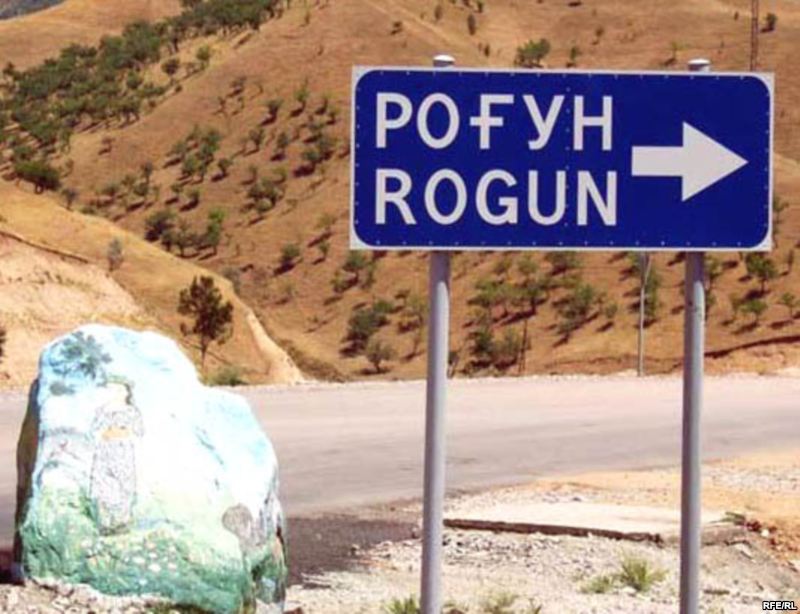
DUSHANBE, March 5, 2012, Asia-Plus -- Washington-based experts from Tajikistan expressed their opposition to the tendency of looking at the problem of water resources in Central Asia through the prism of the Roghun hydropower project stressing that the problem of water in the entire Central Asian region is far more profound and systemic, Silk Road Newsline reported on March 5
Tajik experts presented their arguments during an emotional debate at a seminar at the Central Asia – Caucasus Institute at the Johns Hopkins University in Washington last week, where Elbek Saidov, a visiting scientist from Uzbekistan, presented a report on “Water management in Central Asia: Challenges and Opportunities.” In his report, Saidov mentioned Roghun among several factors that contribute to the complex situation in the field of water resources in Central Asia.
“Don’t you think the main reason of all these difficulties, I mean, the water management that we already have — in these days we’ve already almost lost the Aral Sea, we almost do not have it — and you did not even mention, our esteemed Uzbek, that your country produces 4 million tons of cotton, which, of course, uses the water and you did not mention the artificial lakes that you continue to build in Uzbekistan — there are more than 200 of them — but at the same time you mentioned, more than 20 times, the Roghun hydropower plant in Tajikistan, while the construction of the dam has not even restarted yet,” rebuffed Farhod Salim, Deputy Chief of Mission and the Chargé d’Affaires at the Embassy of Tajikistan in Washington.
Noting that “the World Bank is doing a feasibility study of Roghun,” the Tajik diplomat stressed that “the World Bank is working with all countries of the region on the Roghun issue.”
“The last meeting of the World Bank expert was in Almaty in Kazakhstan. Kyrgyzstan was there, Tajikistan was there, Turkmenistan was there and you know who was not there? Uzbekistan was not present,” Salim said.
According to political scientist Muhiddin Tojiyev, a visiting fellow at the George Mason University in Virginia, the notion that Roghun is being built solely to export electricity to South Asia is also wrong.
“The goal of the construction of the Roghun hydropower plant is not to export to South Asia. The primary goal is to meet the needs of the population in electricity,” he said adding that in many remote areas of Tajikistan electricity supply is still limited to a few hours a day.
Tojiyev demanded to see concrete, scientific evidence that would support the often expressed reservation that the construction of large scale hydropower projects in Central Asia would be harmful to neighboring countries.
“If you have any scientific data, could you please tell what kind of harm can be made to other countries if Roghun is constructed, for example, and not only Roghun but also other big hydropower plants in the region including Kambarata hydropower plant in Kyrgyzstan, about which we also have very big debates?” he asked.
In his report, Saidov, who is also a UNESCO Fellow at the Johns Hopkins University, listed a number of historical, economic and political reasons underlying the problems of water resources in Central Asia. Stressing that these problems also resulted from “extensive development and over-exploitation of natural resources” of the region during the Soviet Union period, he cited the example of construction of the Karakum Canal, as well as the Roghun project.
“Another example is the Roghun Dam, the construction of which began in 1976, and it would be the highest dam in the world but it left a lot more questions than answers, that is dam safety, environmental impact, social impact which is not assessed by the expert community,” he said in his presentation. Saidov’s main conclusion was that in solving the problem of water management in Central Asia it is very important to secure a “balance of interests” among all representatives of the region.
“In order to address this problem correctly, all these problems — historical, political, geopolitical, economic and social – should be taken into consideration,” Saidov said. “The water scarcity in the region is not related to lack of water resources but it is a result of mismanagement and supply driven approach. Countries should continue further diversification of economies and agricultural reforms. The other point is that all the parties should come to clear understanding of the benefits of cooperation and refrain from any kind of unilateral actions on trans-boundary rivers, achieving the balance of interests. The balance of interests is the most important thing.”
The discussion following the report was conducted by Dr. Frederick Starr, Chairman of the Central Asia – Caucasus Institute.
According to the World Bank, it is funding two studies on Roghun, including a Techno-Economic Assessment Study (TEAS) being conducted by an international consortium of well known engineering firms of Coyne et Bellier (France), Electroconsult (Italy) and IPA Energy & Water Consulting (UK), as well as an Environmental and Social Impact Assessment (ESIA) conducted by Poyry (Switzerland). Both studies are conducted by international consultant firms contracted on a competitive basis by the Government of Tajikistan and financed through an IDA project with assistance of World Bank experts.
The World Bank has also established two independent Panels of Experts (PoEs): an Engineering and Dam Safety Panel and an Environmental and Social Impact Assessment Panel. The role of the Panels is to ensure due diligence and international quality standards, as well as objectivity and credibility through independent advice and guidance. The Panels of Experts are composed of recognized international professionals.
The proposed Roghun Hydropower Project (HPP) on the Vakhsh River in Tajikistan with a total capacity of 3,600 megawatt would be the highest dam in the world with a maximum height of 335 meters and surpassing China’s Three Gorges dam built in 2008. Roghun HPP is expected to produce 13.3 Terawatthours [TWh – trillion watthours] of electrical power per year.
“Due to significant changes in hydropower development and climate science over the past three decades, Tajikistan needs to apply modern international knowledge and standards to ascertain the public safety and long-term economic viability of the project. Moreover, for credibility in the international community, there needs to be a transparent due diligence process following international practices, overseen by independent experts,” the World Bank said in its latest official Update on the Status of the Roghun Assessment Studies released in Washington last December.
“During a recent visit to Tajikistan, the World Bank Director for Strategy and Operations for the Europe and Central Asia Region, Mr. Theodore Ahlers, reviewed the status of the Rogun Assessment Studies with the Government of Tajikistan. Both parties reiterated the importance of completing the studies using accepted international standards in order to thoroughly investigate and address dam safety, environmental and socio-economic issues,” the Update said.
Construction of Roghun HPP began in 1976 but the project was frozen following the collapse of the Soviet Union. As Roghun stood idle without conserving the construction site, its bedding was washed away and the price tag has ballooned. According to some estimates it stands now at over $3.5 billion.
According to published reports, the Government of Tajikistan has financed the new construction at Roghun to the tune of $420 million between 2009 and 2011 with plans to spend another $223 million on the project in 2012.


Eid al-Fitr greetings
Russian ruble weakens against the Tajik national currency and major global currencies
Over 2,500 participants expected at Water Conference in Dushanbe
BARQ becomes new IT Park Dushanbe resident, launches power bank rental service
Some bazaars and shopping centers in Dushanbe to close for up to four days during Navrouz celebrations
Eurasian Development Bank Predicts 8.1% Economic Growth for Tajikistan in 2026
Iran’s intelligence minister killed in air strike
Russian parliament tightens immigration rules for migrant children and patent holders
Tajikistan joins UN Convention against Cybercrime
The online HIV test delivery service has become available across all regions of Tajikistan.
All news
Авторизуйтесь, пожалуйста