




DUSHANBE, September 4, 2014, Asia-Plus -- The final Environmental and Social Impact Assessment (ESIA) Report, conducted by Poyry Energy Ltd (Switzerland), notes that the Roghun Hydropower Project (HPP) site lies about 110 kilometers east of Dushanbe, and the HPP would become the uppermost of a planned and partly built hydropower cascade on the Vakhsh river.
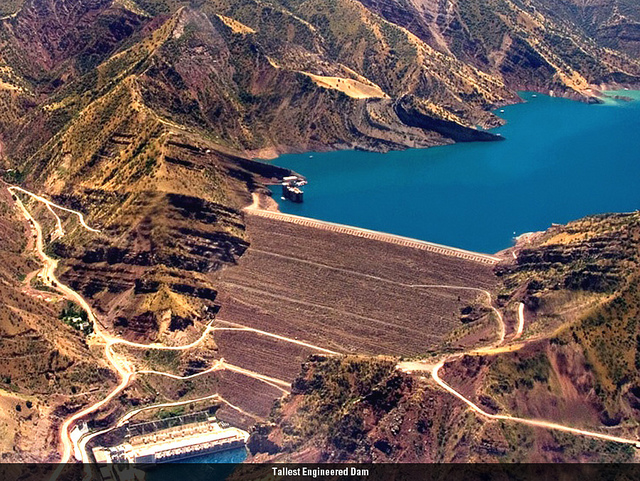
Of most importance is Nurek HPP, 70 kilometers downstream from Roghun, which has operated since the 1980. The Nurek HPP includes a high dam – at 300 meters the highest in the world -- and a reservoir with a storage capacity of 10.5 km3. Nurek is operated in such a way as to shift about 4.2 km3 of water from summer to winter to meet Tajikistan’s electricity demand in the cold season. The other HPPs in the cascade are run-of-river (ROR) schemes with little or no storage capacity.
The water level in Nurek reservoir rises and falls over 50 meters over the course of the year. With Roghun HPP in place, however, the Nurek reservoir is intended to be maintained at a constant level, while the Roghun reservoir would be used for water regulation, with its reservoir water level varying by about 30 meters. Thus, the seasonal flow pattern established by Nurek would remain unchanged, since Nurek would effectively become a run-of-river operation. In effect, the same water that is now used once to generate winter electricity at Nurek would in future be used twice, once in Roghun and then again in Nurek, without changing the downstream flow pattern.
The ESIA Report notes that the Nurek HPP is not designed to handle the Probable Maximum Flood, and this places both the facility and downstream areas at some risk. Roghun, on the other hand, is so designed, and its storage capacity and water regulation capability would allow it to control flows so as to protect Nurek and the downstream cascade. Even so, dam break scenarios and wave propagation studies would need to be undertaken and emergency preparedness and response plans developed prior to reservoir filling.
The Report says that by retaining the high sediment load which otherwise would reach and fill Nurek reservoir, Roghun would effectively extend the life of Nurek HPP and the Vakhsh cascade by over 100 years.
According to the ESIA Report, the Roghun HPP would not have significant adverse effects on any protected area if the cascade is operated as intended. The Tigrovaya Balka State National Reserve lies on the Vakhsh river downstream of the Roghun site and Nurek reservoir near Vakhsh’s confluence with Panj River. This area is one of the few remaining Tugai riparian habitats. Tigrovaya Balka has suffered from flow changes caused by Nurek HPP, in particular the reduction in summer flows and floods. The intended operating regime for Roghun HPP is not expected to cause any further effects on Tigrovaya Balka, and could even provide the opportunity for some improvements through planned floods, although these would need to be carefully managed to avoid downstream damage.


Tajik-Japan Digital Business Connect held in Tokyo on sidelines of the "Central Asia – Japan" Summit
Why fines won’t fix Tajikistan’s soaring meat prices
European Union supports IFAD and Bank Arvand partnership to harness remittances for rural development in Tajikistan
Tajikistan’s Ombudsman appeals to Russian authorities over killing of 10-year-old Qobiljon in Moscow region
ADB supports glacier monitoring and disaster resilience in Tajikistan
Kazakhstan and Tajikistan target $2 billion trade turnover
Tajikistan’s economy remains the most dependent on migrant remittances worldwide
President of Tajikistan dismisses several judges, three for "dishonorable conduct"
Body of 10-year-old Qobiljon, killed in school xenophobic attack in Russia returned to Tajikistan
An evening when all the stars aligned: Tarona Music Award 2025 held in Dushanbe
All news