




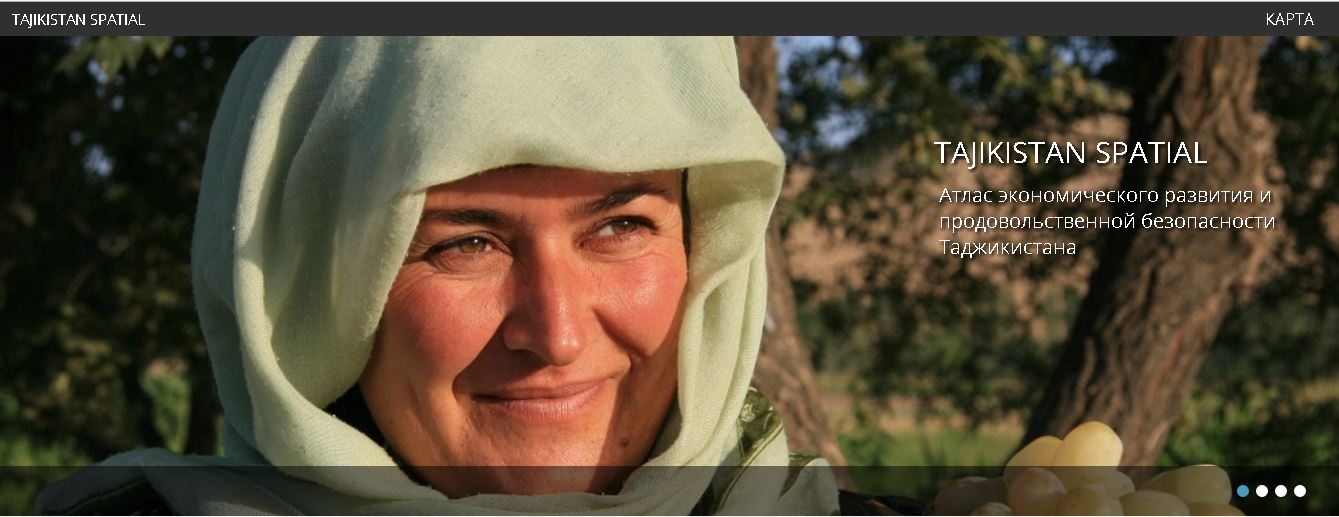
The University of Central Asia’s Institute of Public Policy and Administration (UCA IPPA) and the International Food Policy Research Institute (IFPRI) have launched Tajikistan Spatial, a new online platform to help policy makers target areas of the country most vulnerable to food insecurity.
The platform was launched in collaboration with the Local Development Committee under the President of Tajikistan. The Committee will promote the use of the online platform among policy-makers and researchers in Tajikisitan.
UCA says Tajikistan Spatial is an interactive online mapping tool and knowledge platform designed to support evidence-based decision making in agriculture and food security. The platform is based on technology developed for Arab Spatial and Kyrgyzstan Spatial, two IFPRI-led initiatives providing agricultural data from Middle Eastern countries and Kyrgyzstan, through support from the International Fund for Agricultural Development (IFAD), the Ministry of Finance of the Russian Federation and the Consultative Group on International Agricultural Research’s (CGIAR) Policies, Institutions and Markets Program. Tajikistan Spatial can be accessed online at: www.tajikistanspatial.org.
“Tajikistan Spatial is a practical visual tool that provides easy, structured access to verified data from official resources. Such a platform will provide crucial support to policy makers and practitioners as they analyze, assess, anticipate and respond to the country’s agriculture and food security needs,” explained Dr. Roman Mogilevskii, IPPA Associate Director.
With data provided on more than 100 indicators, including climate, biophysical and socio-economic factors, Tajikistan Spatial enables users to visualize areas most vulnerable to food insecurity and target policies and research where they are most needed. The tool can accommodate any number of layers at national, sub-national and pixel levels, show a dynamic display of indicators over time, and download and print maps and graphs.
The platform incorporates innovative technology and mapping concepts, using data from a broad range of sources, including the Government of Tajikistan, the World Bank, the Food and Agriculture Organization of the United Nations (FAO), and household surveys such as the Multiple Indicator Cluster Survey and the Demographic and Health Survey.
“Economic development plays an important role in achieving food and nutrition security, especially for young children and women,” said Dr. Kamiljon Akramov, Research Fellow at IFPRI and Leader of IFPRI’s Central Asia Program. “Food and nutrition security, in turn, impacts productivity and hence the economic development of nations. Tajikistan Spatial highlights this link at national, regional, local and household levels. Hopefully, this tool will help to promote research, policy analysis and evidence-based decision making not only at national level but also in the regions.”
Tajikistan Spatial is accessible to the public online in both English and Russian. The dynamic platform is updated and expanded on a regular basis, and submissions of new information from partners and stakeholders are welcome to continually improve the tool and assist in delivering appropriate policies and interventions across Tajikistan.
IFPRI is partnering with UCA as part of the Institute’s Central Asia Research and Capacity Strengthening Program. Under the partnership, UCA is collecting, processing and entering data to create and maintain page content. IFPRI’s team trained UCA staff and shared their experience developing Kyrgyzstan Spatial. They also provided technical support to ensure content quality.
Tajikistan Spatial is a collaborative project of IFPRI and UCA, supported by the CGIAR Research Programs on Policies, Institutions, and Markets and Agriculture for Nutrition and Health, the Ministry of Finance of the Russian Federation, and IFAD.

Eurasian Development Bank Predicts 8.1% Economic Growth for Tajikistan in 2026
Iran’s intelligence minister killed in air strike
Russian parliament tightens immigration rules for migrant children and patent holders
Tajikistan joins UN Convention against Cybercrime
The online HIV test delivery service has become available across all regions of Tajikistan.
Blind workers’ factory in Hisor falls into ruin as residents appeal for president’s intervention
Tajikistan publishes first-ever practical guide to the stock market
Tajikistan to require $2 billion for transport development over the next five years
Who sets meat price limits in Tajikistan?
Tajikistan to draw global bloggers and media attention during Navrouz
All news
Авторизуйтесь, пожалуйста