




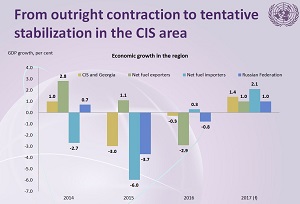
Following the terms-of-trade shock and economic downturn of 2014-2015, the Commonwealth of Independent States (CIS) region entered a period of tentative stabilization in 2016 and is expected to return to growth in 2017, the United Nations World Economic Situation and Prospects (WESP) 2017 Report says.
The report shows that world gross product grew by just 2.2 per cent in 2016, marking its slowest pace of expansion since the Great Recession of 2009. Global growth is projected to see a moderate improvement to 2.7 per cent in 2017 and 2.9 per cent in 2018, but this is more an indication of economic stabilization than a signal of a robust revival of global demand.
In this environment, the aggregate GDP of the CIS and Georgia, which is estimated to have fallen by 0.3 per cent in 2016, is projected to expand by 1.4 per cent in 2017 and 2.0 per cent in 2018. Relatively low commodity prices, ongoing geopolitical tensions and persistent structural constraints, such as an outdated capital stock and demographic pressures in parts of the region, have continued to generate a challenging growth environment. The region’s larger economies are expected to remain on a low-growth trajectory.
The report notes that on the positive side, stronger links with China, in particular within the framework of the “Belt and Road” initiative, will contribute to an upgrade of the Central Asian infrastructure grid and have positive spillover effects.
The report notes that consumption and investment demand remains weak in the CIS amid stagnating or declining real wages, limited access to credit and high uncertainty. The continuing international sanctions against the Russian Federation, which restrict access to capital markets, are weighing on business sentiment and investment prospects.
The report also states that inflation subsided in the CIS in 2016, as the impact of past currency depreciations wore off, exchange rates stabilized and aggregate demand remained subdued. Strong harvests in the Russian Federation and Ukraine contributed to disinflation. A further slowdown in inflation is projected for 2017-2018. Monetary policy was generally loosened throughout the CIS in 2016, against the backdrop of slowing inflation. However, in the larger countries, interest rates remain relatively high. Persistent concerns over exchange rate stability and inflation limit the scope for countercyclical monetary policy.
The report cautions that there are significant risks to the global and the regional outlook. Among other issues, the report highlights the high degree of uncertainty in the international policy environment and elevated foreign currency-denominated debt levels as key downside risks that may derail global growth.
For the CIS, the report warns that the economic outlook faces continued downside risks. Geopolitical risks are undermining confidence and business sentiment in the region. The banking system remains fragile, although immediate concerns about financial stability have receded. Volatile currencies continue to generate high uncertainty. The region also faces persistent structural weaknesses, including overdependence on primary commodities and low-tech exports, inadequate access to modern technology and limited resources for investment.
The report calls for a more balanced policy approach to not only restore robust growth in the medium term, but also to achieve greater progress on sustainable development.
The World Economic Situation and Prospects Report is the UN’s flagship publication on expected trends in the global economy. The WESP is produced annually by the UN Department of Economic and Social Affairs (UN/DESA), the UN Conference on Trade and Development (UNCTAD), the five UN regional commissions and the World Tourism Organization (UNWTO).


Number of farmers in Tajikistan increases
Chief customs officer claims "tax burden in Tajikistan is low"
“Three prisoners neutralized.” The prosecutor-general provides details on the shooting in Khujand detention center
Media: Tajikistan’s ambassador to Afghanistan meets with Taliban foreign minister
Fishing rods, mountains, hospitality: fishing tourism in Tajikistan: from potential to sustainable development
Tajikistan’s public debt decreases by $100 million in the past Year
"I protected my friend": Sadyr Japarov explains his decision to dismiss Kamchybek Tashiyev
"Children's rights are being violated": Tajikistan's Ombudsman expresses concern over exclusion of migrant children from education in Russia
Chairman of the Supreme Court provides details of family murder in Roudaki district
Ministry of internal affairs comments on fatal accident in Dushanbe
All news
Авторизуйтесь, пожалуйста