




Several developments suggest that the often-troubled relationship between Russia and Tajikistan is on the upswing, EurasiaNet.org reports, noting that there is lots of speculation that Dushanbe may finally agree to become a member of the Eurasian Economic Union (EAEU).
Dmitry Peskov, a spokesman for Russian resident, recently announced that the Russian leader will soon embark on a tour of Central Asia, taking in Tajikistan and neighboring Kyrgyzstan. The exact dates of the trip remain subject to discussions.
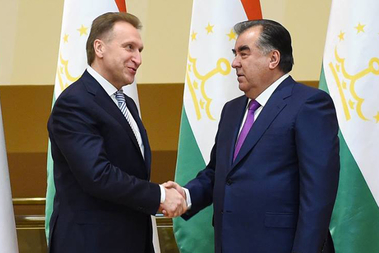
Russian Deputy Prime Minister Igor Shuvalov laid the groundwork for the tour during a visit to Tajikistan on January 27. He was in Dushanbe to participate in the 14th session of the Tajik-Russian commission for trade and economic cooperation. Items on the agenda included cooperation in trade, investment, energy, education, science and migration.
In reality, the session’s main task was to resolve an aviation dispute that has been dragging on since late last year, according to EurasiaNet.org.
While in Dushanbe, Shuvalov attended the opening of a representative office of the Russian Export Center (RETs) — a government-backed company that facilitates the operations of Russian exporters abroad.
RETs representatives describe Tajikistan as a “key” destination for Russian goods and services in the former Soviet space. “In our portfolio, we have 20 Russian-Tajik projects worth $33 million, and an equivalent amount of projects are under development,” said chief executive Pyotr Fradkov.
The prospect of such business relations may whet the appetite, but it is the fate of Tajikistan’s hundreds of thousands of citizens working in Russia.
According to figures from the Main Directorate for Migration Affairs in Moscow, there were almost 900,000 Tajik citizens living in Russia in late 2016. Tajiks comprise the second-largest contingent of labor migrants from Central Asia after much more populous Uzbekistan, which accounts for 2 million workers in the Russia’s economy.
Two developments have reportedly threatened that economic lifeline in recent years. One is the knock-on effect of low oil prices on Russia’s economy, whose poor performance has, in turn, depressed job prospects for Tajik expatriates. Another more readily addressable matter is the bureaucratic hurdles thrown in the way of prospective migrants.
Rahmon said last week the two countries plan to sign agreements to strengthen social and legal protections for Tajik labor migrants in Russia. One document to emerge from the inter-governmental economic commission session envisioned the creation of “specialized adaptation centers” for Tajik migrants in Russia.
Russian news website Life.ru has reported that under one provision in the agreement under discussion, once an employer in Russia unilaterally tears up a work contract with a Tajik citizen, the fired employee will be required to leave the country within 15 days. Tajikistan is reportedly hoping to secure pledges from Moscow to allow its citizens to remain in Russia and seek new employment even after they lose their job.
Those objecting to Dushanbe’s position claim that to allow an open-ended stay would open the way to masses of Tajik citizens living in Russia illegally. But Gavhar Jourayeva, a migrant rights advocate, argued that the provision being sought by Tajikistan would provide workers with basic rights.
“You cannot turn a migrant worker into a serf,” Jourayeva told Life.ru. “If Tajikistan’s demands are met, it will simply protect migrants from unscrupulous employers.”
Rahmon is also holding out for more assistance from Russia in the educational sector. Tajikistan would like to see Moscow raise admittance quotas for young people aspiring to enroll in Russian universities.
The elephant in the room in all these matters is Tajikistan’s heretofore cool stance toward the EAEU, EurasiaNet.org says.
Tajikistan is for now sticking fast to its wait-and-see policy.
When Putin arrives in Dushanbe later this year, it may be just to sign off on some relatively trivial trade and cultural agreements. Or it may be the latest step in Moscow’s ambition to definitively cement another nation within in its sphere of economic and political influence, according EurasiaNet.org.


Who Emomali Rahmon criticized — and praised — in 2025
Trump announces plans for US ground operation against Mexican drug cartels
Emomali Rahmon shakes up police officials
Tajik citizen extradited from Azerbaijan to homeland
Tajik somoni strengthens against the dollar and the euro in 2025, weakens slightly to the Russian ruble
How Tajikistan's farmers are adapting to climate change
VIPzone winter issue: key faces, trends, and stories of 2025
186 facilities in Tajikistan suspended in 2025 for sanitary violations
Tajikistan’s debt web: who holds the strings?
Amir Tour named best domestic tourism company in Tajikistan
All news
Авторизуйтесь, пожалуйста