




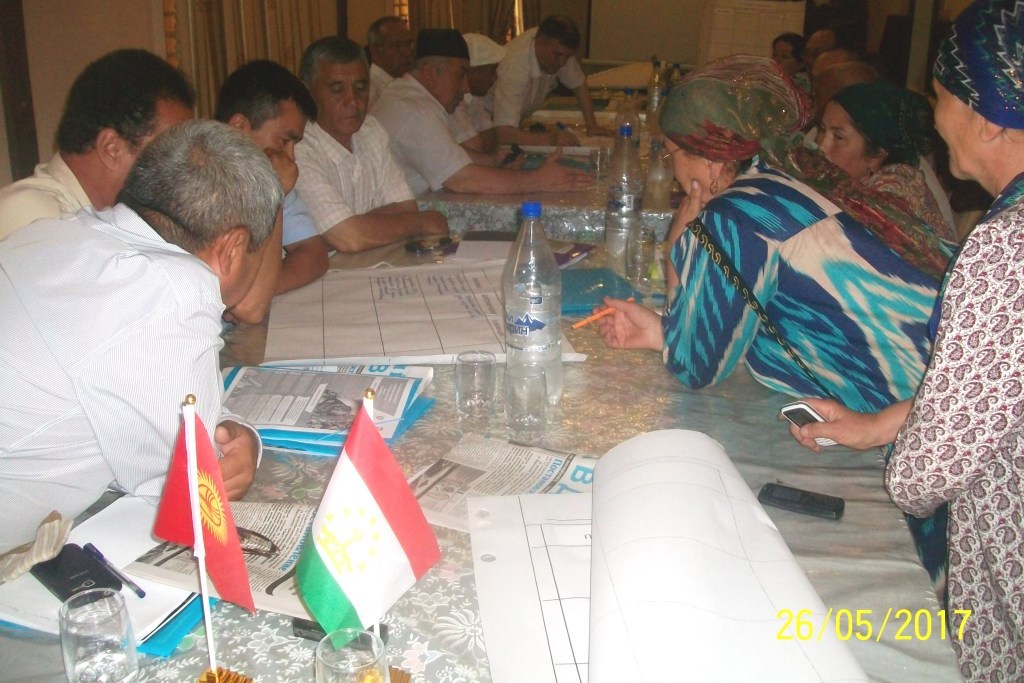
Residents of border areas of Tajikistan and Kyrgyzstan believe that cross-border trade can not only promote providing stability and developing confidence-building measures but also help solve economic problems facing residents of border areas.
A meeting to discuss development of a cross-border trade between the Bobojonghafourov district in Tajikistan’s Sughd province and the Leilek district in Kyrgyzstan’s Batken region took place in the Tajik jamoat of Khistevarz on May 27.
The meeting participants included representatives of local authorities and entrepreneurs from both districts.
They discussed state and prospects of further expansion the cross-border trade between border districts of the two countries.
Touching upon the issues related to the logistic problems and the border crossing procedures, the meeting participants, in particular, proposed to make amendments to the relevant laws of both countries.
Recall, 35 representatives of border communities from Tajikistan’s Isfara district and Kyrgyzstan’s Batken district met in the Tajik northern city of Isfara on April 12 to discuss ways to promote expansion of the cross-border trade between the regions.
The meeting participants discussed state of economic cooperation between border villages and ways to revive trade ties between the border areas of the two countries.
They noted that the cross-border trade could become a bridge to restore confidence between border communities of Tajikistan and Kyrgyzstan.
Besides, a group of farmers and entrepreneurs from Kyrgyzstan’s Batken region visited the villages of Chorkuh, Vorukh and Surkh in the Tajik northern district of Isfara from April 30 to May 7.
Skirmishes have sparked between residents of Isfara and Batken districts along the Kyrgyzstan-Tajikistan border.
The area at the focus of those skirmishes lies on the jagged frontier where the east of Tajikistan’s Sughd province and Kyrgyzstan’s Batken province meet.
The two countries have been unable to agree on the location of the border they inherited when the Soviet Union collapsed in 1991. As the population in the dense Ferghana Valley grows, it has become increasingly difficult to demarcate the contested sections, where valuable agricultural land often lies.


Iran’s intelligence minister killed in air strike
Russian parliament tightens immigration rules for migrant children and patent holders
Tajikistan joins UN Convention against Cybercrime
The online HIV test delivery service has become available across all regions of Tajikistan.
Blind workers’ factory in Hisor falls into ruin as residents appeal for president’s intervention
Tajikistan publishes first-ever practical guide to the stock market
Tajikistan to require $2 billion for transport development over the next five years
Who sets meat price limits in Tajikistan?
Tajikistan to draw global bloggers and media attention during Navrouz
Tajikistan sends humanitarian aid to Iran
All news
Авторизуйтесь, пожалуйста