




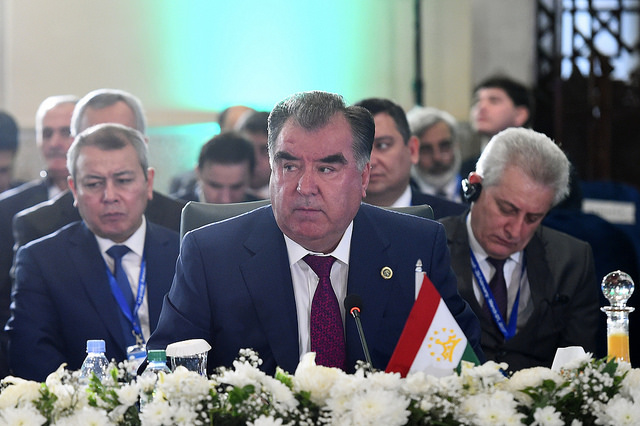
In a statement delivered at the 13th Economic Cooperation Organization (ECO) Summit in Islamabad, Tajik President Emomali Rahmon has called on the OEC members states to expand cooperation in the fields of energy and tourism.
He, in particular, noted that joint efforts of the OEC member nations had made it possible to establish a legal framework of cooperation in priority areas and created a favorable environment for expansion of trade, movement of people and transit operations between the countries.
Development and expansion of multifaceted cooperation with the ECO member countries is one of the important dimensions of Tajikistan’s foreign policy, Rahmon said, noting that the share of ECO member states in Tajikistan’s foreign trade turnover accounts for over 36 percent.
Despite all these achievements, the ECO member states still have a great untapped potential for mutually beneficial cooperation, Tajik leader stressed.
“Our common task is to find out the means and framework for effective cooperation, which would meet the interests and desires of our peoples, and to ensure their implementation,” Rahmon said.
According to him, promotion of a wider integration, intensification of mutual support, expansion of trade and investment are the key elements of regional cooperation.
Tajik leader called on the Summit participants to connect roads and sea routes through the establishment of transport corridors and thereby strengthen the Organization member nations’ economic growth and potential in addressing social issues.
Rahmon expressed hope that the ECO member states will further contribute to the implementation of projects on connectivity and establishment of regional energy grids and creation of energy market.
“In this regard, the implementation of the high-voltage electricity transmission line – CASA-1000, which is acknowledged to be the first energy bridge between South and Central Asia regions, is a timely initiative,” the Tajik president said.
He also noted that with a view to ensuring power generation and consumption, the Government of Tajikistan has undertaken measures to rehabilitate the existing power plants, construct new energy facilities, widely use other renewable energy sources and introduce modern energy saving methods.
“These measures, alongside with ensuring energy security at the national level, are also of regional importance, since they are aimed at meeting the ever growing demand of our far and close neighbors in energy,” Rahmon noted.
According to him, there are two more important aspects in the set of water issues, which deserve the ECO member states’ attention.
First, population growth in the region and everyday growing need in water resources due to ensuring food security, which creates new tasks. In this context, wider introduction of integrated water resources management and effective water use should be another direction of our cooperation.
Second, climate change has been accelerating due to the global warming. “Unfortunately, our countries are hit by the negative impact of this process and consequences of water related natural disasters,” said Rahmon. “For instance, in Tajikistan natural disasters annually cause huge economic losses and human casualties. Extensive rains and floods, mudflows and landslides, high level of snowfall and avalanches cause huge losses to our economy and create obstacles for sustainable social and economic development.”
He noted that it was high time to develop and implement a proper partnership program within the Organization on natural disaster risk reduction and mutual emergency support.
Rahmon noted that another promising area of cooperation was tourism.
“Tajikistan has a favorable climate, beautiful nature with unique landscapes and many historical and civilizational sites attracting tourists,” said Tajik leader. “Given these opportunities, the Government of Tajikistan has been developing and implementing specific public programs on tourism development. Within these programs we envisage a number of privileges and benefits in the tourism sector, including for import of equipment and other materials for development of tourism infrastructure. There is no doubt that expansion of cooperation between the ECO member states in this area would serve as another influential factor for sustainable development of our countries and as an effective tool for strengthening people-to-people ties.”


Number of farmers in Tajikistan increases
Chief customs officer claims "tax burden in Tajikistan is low"
“Three prisoners neutralized.” The prosecutor-general provides details on the shooting in Khujand detention center
Media: Tajikistan’s ambassador to Afghanistan meets with Taliban foreign minister
Fishing rods, mountains, hospitality: fishing tourism in Tajikistan: from potential to sustainable development
Tajikistan’s public debt decreases by $100 million in the past Year
"I protected my friend": Sadyr Japarov explains his decision to dismiss Kamchybek Tashiyev
"Children's rights are being violated": Tajikistan's Ombudsman expresses concern over exclusion of migrant children from education in Russia
Chairman of the Supreme Court provides details of family murder in Roudaki district
Ministry of internal affairs comments on fatal accident in Dushanbe
All news
Авторизуйтесь, пожалуйста