




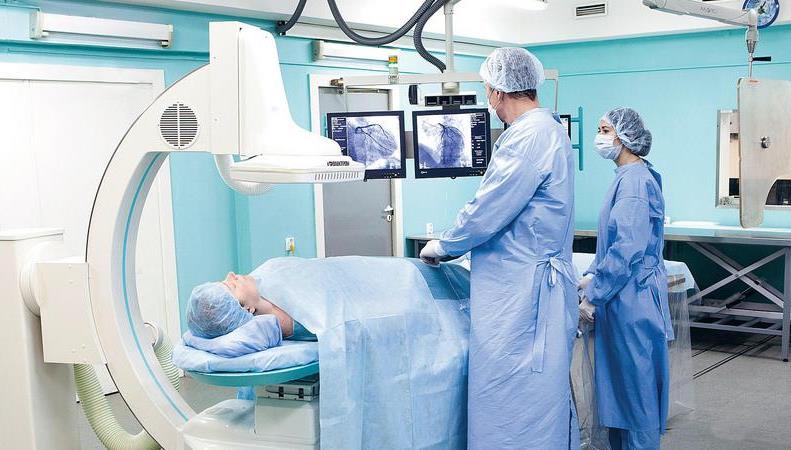
Angiographic equipment is expected to be delivered to Tajikistan for the Ministry of Health and Social Protection soon.
A source at Tajikistan’s lower house (Majlisi Namoyandagon) of parliament says the government has worked out amendments to the country’s law on the national budget for 2017 and submitted them for consideration to the Majlisi Namoyandagon.
According to him, the amendments, in particular, stipulate that delivery of the angiographic equipment to the country will be exempted from payment of the value added tax (TAX)
Angiography or arteriography is a medical imaging technique used to visualize the inside, or lumen, of blood vessels and organs of the body, with particular interest in the arteries, veins, and the heart chambers. This is traditionally done by injecting a radio-opaque contrast agent into the blood vessel and imaging using X-ray based techniques such as fluoroscopy.
Depending on the type of angiogram, access to the blood vessels is gained most commonly through the femoral artery, to look at the left side of the heart and at the arterial system; or the jugular or femoral vein, to look at the right side of the heart and at the venous system. Using a system of guide wires and catheters, a type of contrast agent (which shows up by absorbing the x-rays), is added to the blood to make it visible on the x-ray images.


Tajik woman detained on suspicion of causing death of Russian blogger in botched cosmetic procedure
UK and France to deploy troops to Ukraine if peace deal reached
Mahmurod Ashourov finds Nazirbibi after Asia-Plus publication. He saved her 57 years ago
Tajikistan opens 15 support rooms for violence victims
Uzbek law enforcement agencies reportedly seize 32 Kg of narcotic drugs smuggled from Tajikistan
Cotton prices rise on global markets after long period of decline
Tajikistan ranks 89th in the global Women’s Security Index
Prices for NBT-produced gold bars surge by nearly 40% last year
Imon International announces unprecedented interest rate reduction — up to 8% below standard terms
US power play in Venezuela sends shockwaves through Eurasian energy markets
All news
Авторизуйтесь, пожалуйста