




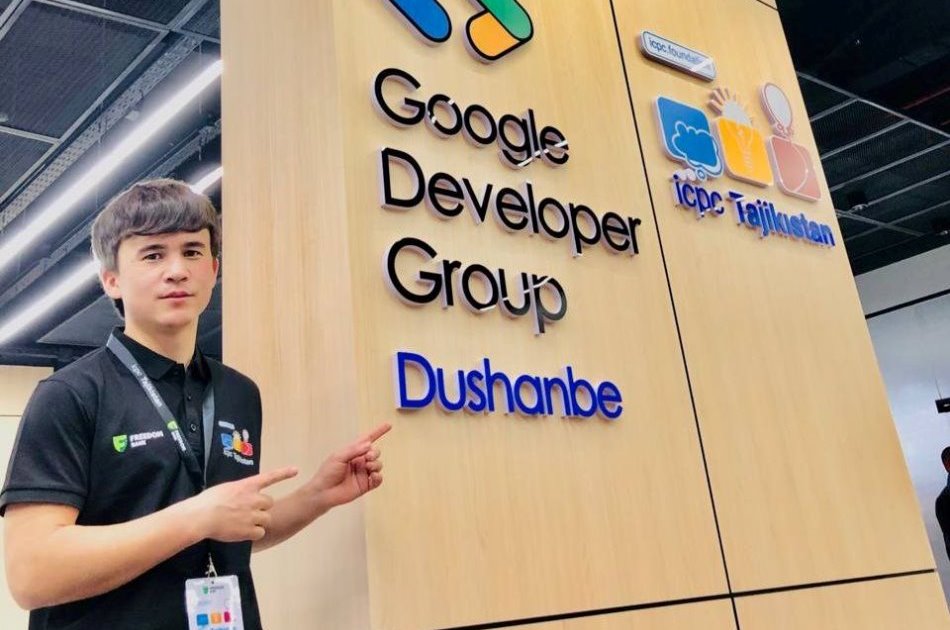
There are many programs today that can convert text into speech and speech into text. However, solutions that work accurately in the Tajik language remain extremely limited. To address this gap, a young Tajik programmer, Abdulaziz Avezov, developed TajikVoice AI, an artificial intelligence system designed specifically for the Tajik language.
TajikVoice AI enables users to generate speech from text and convert audio into text, automatically add subtitles to videos, and use the system in call centers and on news websites. In 2024, the project won first place at the national competition “Science — the Light of Enlightenment.”
Speaking to Asia-Plus, Abdulaziz explained how the idea for the project emerged and what capabilities the system offers.
“I got tired of using online translators. I kept thinking — why does YouTube automatically generate subtitles in Russian but not in Tajik?” he said.
According to him, most programming tutorials are available only in English. Facing this challenge, Abdulaziz decided to create a tool that would allow him and others to work with content in their native language.
“Sometimes I wanted to listen to audiobooks instead of music, but I simply couldn’t find the books I needed in Tajik. Every time I reflected on my own needs, I added new features to the program,” he explained.
A well-deserved award
Abdulaziz presented TajikVoice AI at the “Science — the Light of Enlightenment” competition in the category Artificial Intelligence and Programming. The project scored 77 points, secured first place, and received a cash prize of 70,000 somoni.

This national competition was not his first success. During his school years, Abdulaziz twice won regional competitions for young inventors. His interest in modern technology began in childhood, when he independently studied the basics of robotics through YouTube videos.
“There was no equipment needed to build robots in my village, and I had no idea about online stores back then. I bought remote-controlled cars in the city and used their parts to assemble robots,” he recalled.
Later, he became an apprentice to a mobile phone repair technician, which further strengthened his interest in programming.
What TajikVoice AI can do
According to Abdulaziz, TajikVoice AI removes background noise using 16 kHz technology and recognizes only standard literary speech. The system can convert up to 10,000 words into audio in just 23 seconds.
When integrated into news websites, the program can read articles aloud like a professional news anchor. Speech-to-text accuracy reaches 90–95%, while text-to-speech accuracy is around 85%.
The developer emphasizes that the system is continuously improving. The more actively users interact with it and help it learn new words and correct pronunciation, the higher its performance becomes.
TajikVoice AI can also be used in call centers, where it can analyze call volumes, caller locations, and common inquiries.
“My goal is to make this program, like Russia’s ‘Alice,’ capable of executing voice commands in Tajik — whether in smart homes or office environments,” Abdulaziz says.
At present, TajikVoice AI is not yet available as a mobile application, but it is expected to be released to the public soon. The developer also plans to introduce paid Pro and Business plans in the future.
Abdulaziz hopes that by 2026 the platform will have more than 30,000 users, after which he plans to launch his own startup.

Looking ahead
Abdulaziz believes that young people in Tajikistan have great potential in programming and innovation. One of the main challenges, he says, is the country’s low internet speed, which significantly slows down access to educational materials and software.
After completing his bachelor’s degree at the Osimi Technical University, Abdulaziz plans to pursue a master’s degree at a university in Singapore and eventually work for global companies such as Google, Microsoft, or Amazon.
“Anyone who sets a goal and makes the effort to achieve it will succeed. I truly believe that,” he concludes.
 Руcский
