




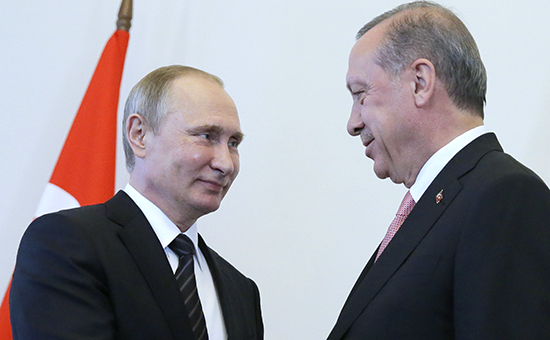
Russian President Vladimir Putin and his Turkish counterpart Recep Tayyip Erdogan met in Istanbul yesterday on the sidelines of the 23rd World Energy Congress, which opened there on October 9.
The presidents have urged a swift end to the bloodshed in war-torn Syria, according to Russia’s RT news agency.
Both Moscow and Ankara reportedly backed the proposal of UN Special Envoy for Syria Staffan de Mistura, regarding the removal of militants from Aleppo.
The Russian president said that he and Erdogan had agreed to strengthen contact between the countries’ militaries and intelligence agencies.
He added that Moscow is ready to develop large-scale military-technical cooperation with Ankara and the sides are now studying various projects.
The Turkish military operation in Syria and ways to cooperate in providing aid to civilians in the city of Aleppo were discussed during the talks in Istanbul on Monday, Erdogan said.
The Russian and Turkish militaries, as well as intelligence services and diplomats from the two countries, will continue to work together on the provision of humanitarian aid in Syria, he added.
“We share a common stance regarding what must be done to deliver humanitarian aid to Aleppo. The issue is ensuring security for the deliveries of this cargo,” Putin said.
During the talks, the two leaders agreed to “speed up the work” on construction of such vital joint projects as the Turkish Stream gas pipeline and the Akkuyu Nuclear Power Plant, the Turkish president said.
Before the two leaders addressed the media, an intergovernmental agreement on the Turkish Stream pipeline was signed in their presence.
Regarding the signing of the Turkish Stream pipeline deal, Putin said that Moscow and Ankara are moving forward with plans to create a major energy hub in Turkey.
The Turkish Stream gas pipeline would see Russian natural gas delivered directly to Turkey via the Russian Black Sea coast and on to Greece. The project, with an estimated total cost of 11.4 billion euros, was initially unveiled by Putin in December 2014 during a visit to Turkey as an alternative to the canceled South Stream route through Bulgaria. After the downing of a Russian jet in November 2015, Russia suspended the project. It was revived only after Turkey publicly apologized for the incident in August.
The capacity of the pipeline would reach some 32 billion cubic meters per year, from which Turkey would take 15.75 billion cubic meters in the first leg of the pipeline, transiting the rest to Europe via the second leg. The construction of pipelines was expected to be finalized by 2019.
Russia and Turkey signed an agreement for the construction of the Akkuyu nuclear plant, with four 1,200 MW reactors in May 2010. It will be built by Russia’s Rosatom back and the first block of the $22 billion power station is expected to be introduced into operation in 2020.


Tajikistan welcomes Iran-U.S. talks and advocates for peaceful conflict resolution
‘Tajik national clothing complies with Islamic norms and cultural traditions,’ says Tajik official
India, Turkmenistan Hold High-Level Talks in Ashgabat to Deepen Economic and Strategic Cooperation
"They are fraudsters and criminals." Dushanbe deputy mayor promises to identify companies defrauding citizens in housing sales
Tajikistan's Antimonopoly Service identifies market "giants"
New multi-level parking lots to be built in Dushanbe this year
Seven avalanches hit Dushanbe-Chanak highway, and it is temporarily closed for traffic
Drug smuggling from Afghanistan to Tajikistan grows, armed clashes increase
Tajikistan plans to introduce a visa-free regime for Chinese citizens
Tajikistan officially becomes a candidate to host the 2031 AFC Asian Cup
All news
Авторизуйтесь, пожалуйста