




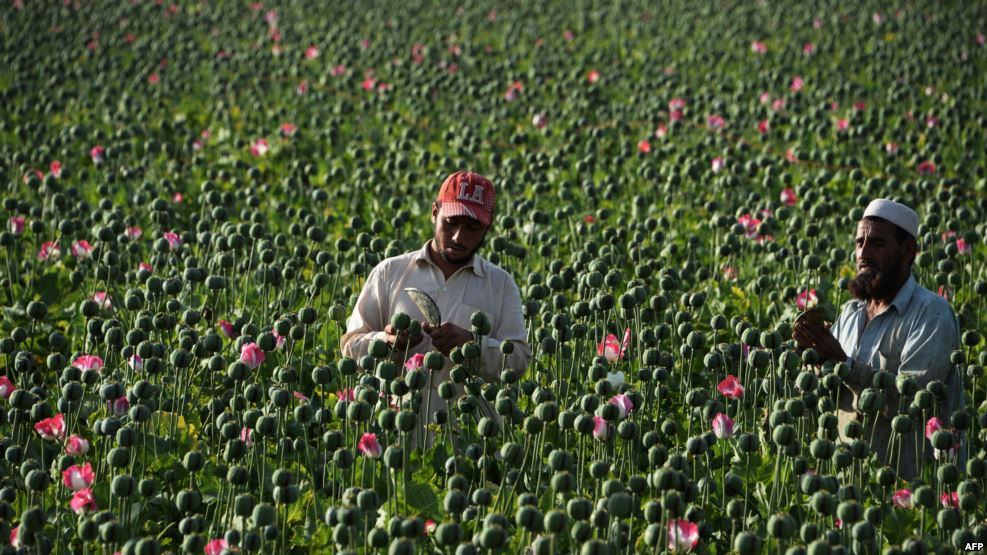
The United Nations confirmed on October 23 that the cultivation of opium poppy in Afghanistan, the world's main source of heroin, has risen to its third-highest level in more than 20 years.
In the key findings of its Afghanistan Opium Survey 2016, the U.N. Office on Drugs and Crime (UNODC) said the total area of land devoted to poppy cultivation had risen 10 percent in 2016 to 201,000 hectares.
“The survey shows a worrying reversal in efforts to combat the persistent problem of illicit drugs and their impact on development, health and security,” UNODC Executive Director Yury Fedotov said in a statement.
The government's loosening grip on security in many areas contributed to a collapse in poppy eradication efforts, a method championed by the United States after it led an invasion of Afghanistan in 2001 when the country was under Taliban rule.
A total of 355 hectares of poppy eradication was carried out by the provincial governors in 2016, according to the report.
In 2016, eradication took place in 7 provinces (compared to 12 provinces in 2015): Badakhshan, Kandahar, Laghman, Nangarhar, Nimroz, Sari Pul and Takhar.
Most of the poppy eradication took place in Badakhshan province (270 hectares; 78% less than in 2015).
No eradication took place in the provinces with high levels of opium poppy cultivation due to the extremely poor security situation in those areas and logistical/financial challenges to organize the eradication teams on time.
In 2016, farmers’ resistance against poppy eradication operations was occasionally expressed through direct attacks on eradication teams, the report said, noting that 8 persons (1 ANA officer and 7 insurgents) were killed and 7 persons were injured (2 ANA officers, 1 ALP officer, 1 ANP officer and 3 insurgents) during the eradication operations.
In 2016, the estimated potential opium production in Afghanistan reportedly amounted to 4,800 tons (4,000-5,600 tons), an increase of 43% from its 2015 level (3,300 tons). The average opium yield was 23.8 kilograms per hectare, which is 30% higher than in 2015 (18.3 kilograms per hectare). There were no widespread reports of any diseases affecting the quality of the opium poppy crop.


Tajikistan begins implementing CIS agreement on locust control
Tajikistan needs about $1 Billion annually to tackle climate change
Nearly 30 Cultural Heritage Protection Projects Launched by the European Union and ALIPH in Central Asia
Fears of Iranian refugee influx grow in Central Asia as war intensifies
Former head of Sughd regional health department released after paying fine in bribery case
How much does school education actually cost in Tajikistan?
From markets to online platforms: how consumer rights are protected in Tajikistan
European investment fund to invest over $200 Million in Tajik new privately-owned airline
Debt trap: how to take a loan in Tajikistan without regretting it
Tajikistan citizen killed by unknown gunmen in Afghanistan’s Kunduz, afghan media outlets report
All news
Авторизуйтесь, пожалуйста