





In China, artificial intelligence has long moved beyond the realm of programmers’ experiments. Today, it paints, inspires designers with new silhouettes, invents prints, and even helps orchestrate fireworks. Crucially, it doesn’t replace the human creator — it collaborates. Here, AI is seen less as a rival and more as a co-author, opening doors to realms of imagination a single artist could never reach alone.
Gunpowder meets algorithms
In Macau, the halls of MGM smell faintly of both gunpowder and code. Digital fireworks erupt across the walls while, nearby, a robotic arm carefully ignites powder on canvas.
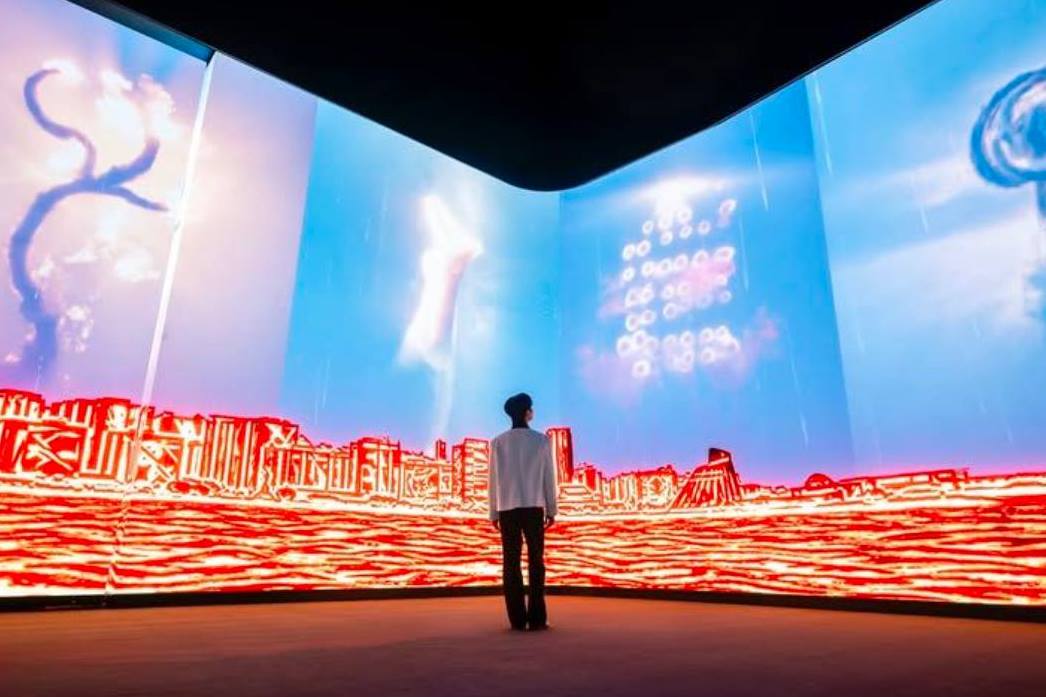
This is the work of Cai Guo-Qiang, the world-famous artist known for his explosive technique, who has now trained AI in his unique visual language.
His project, cAI Lab 2.0, is more than an exhibition — it’s a meeting of centuries-old craftsmanship and split-second algorithmic inspiration. Visitors can pick up an old-fashioned telephone to “talk” to the AI artist, watch it “dream” a painting, and then see those dreams transformed into tangible works.
Where AI turns viewers into artists
In Wuhan’s Optics Valley tech district, a sprawling 2,000-square-meter art space is filled with works born from human–machine collaboration. One glance at a canvas reveals a cityscape whose twisted streets no human architect could imagine.

In an interactive zone, visitors type a few words into a console and — seconds later — watch a unique image appear and print instantly. This is art that doesn’t sit behind glass; it breathes with the audience.
In Shenzhen’s Guan Shanyue Museum, the exhibition The Upcoming Trend: Poetry and Thoughts in the Age of Artificial Intelligence feels like stepping into someone else’s dream. On screens, lines of poetry form in real time, paired instantly with visuals and music — as though the AI itself is telling its own stories. Here, the human artist is less an author and more a curator of dialogue between viewer and machine.
When AI dresses the runway
AI’s biggest surprise has perhaps come in fashion. China made an early statement in 2022 with Fashion X AI in Hong Kong, where over 80 runway looks began as sketches refined by an AI assistant named AiDA. Designers uploaded concepts and reference images, received dozens of AI-generated variations, and then transformed them into physical garments with traditional skill and craft.

This idea evolved when artist Lulu Li teamed up with Moncler to create a prêt-à-porter collection. Her AI-generated silhouettes and vivid prints became the blueprint for real down jackets, dresses, and sweatshirts — moving seamlessly from digital fantasy to atelier reality.
Models who never tire
Today, virtual models in China host livestreams, promote clothing, and walk AI-generated runways. They don’t tire, arrive late, or need makeup — and can model five collections in five “cities” in a single day. Yet behind their flawless faces is a team of designers, 3D artists, and marketers.

AI is no longer just an engineer’s tool. It is entering artist studios, fashion runways, and museum galleries, reshaping the very fabric of China’s cultural life. Algorithms now create paintings indistinguishable from classic masters, design collections ready for the runway just hours after inception, and even co-author theatrical performances.
In Beijing and Shanghai galleries, AI installations sit beside traditional ink paintings, sparking dialogue between past and future. Chinese designers increasingly turn to neural networks not for novelty, but to push the boundaries of form and color. The technology suggests unexpected fabric combinations, drafts entire clothing lines, and “brings them to life” in VR runway shows.
Most importantly, AI has become not just a tool, but a cultural protagonist. China now has AI “artists” with thousands of followers exhibiting alongside humans — and audiences seem to welcome them as a new wave of creative energy capable of reimagining traditions and setting the trends of tomorrow.
 Руcский
