




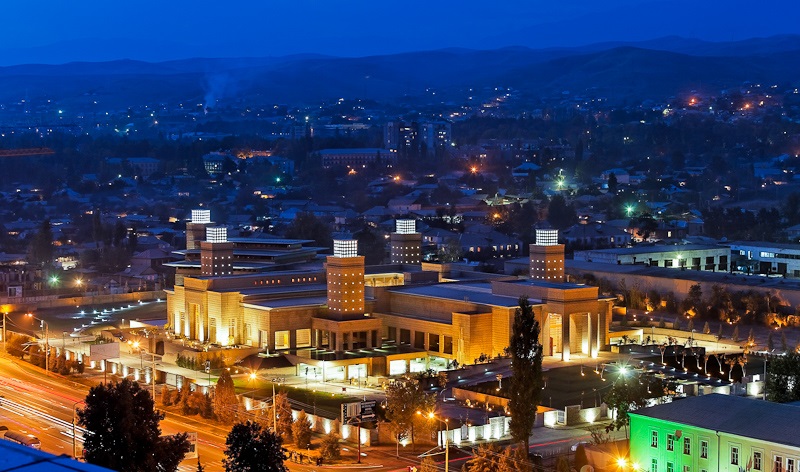
The Dushanbe Ismaili Center is expected to open its doors on February 1.
The Dushanbe Ismaili Center is not only a place for religious events it also hosts various cultural events, fairs and open lectures. Besides, it organizes various educational courses, in particular for children
Meanwhile, representatives of the Center say it will still be open for prayer only. The prayer hall reportedly accommodates up to 1,500 people, but because of the coronavirus pandemic only 700 people will still be allowed to pray in the prayer hall.
Visitors must observe health and sanitary rules: wear face masks; refuse to shake hands; and observe a social distancing of 1.5 meters. They also need to use their own utensils to drink water.
“After the opening of the Center for prayer, it will be clear whether other activities can be re-launched, in particular courses for children,” a source said.
The Dushanbe Ismaili Center has been closed since March 5, 2020 due to the coronavirus pandemic.
Opened in 2009, the Ismaili Center, Dushanbe is the first such Center in Central Asia — a region that has been home to Ismaili Muslims for more than a thousand years. It stands as both a reminder of great history and accomplishment, and a call on the peoples of the region to reflect on that inheritance as they shape the world of tomorrow.
Inspired by some of the region’s most distinctive monuments, the architecture of the Ismaili Center in Dushanbe blends many craft and artisanal traditions of Central Asia. It is designed to facilitate cultural and intellectual exchange, and to re-invigorate the spirit of enquiry characterized by scholars whose contributions over the centuries were encouraged by the Ismaili Muslim community under the patronage of its leadership.
The detailing throughout the Center includes elaborately carved plaster, doors, wood beams and creative use of brick. These are a feature of traditional Tajik architecture. Clay bricks, punctuated with blue and turquoise glaze, became the most distinctive visual aspect of the Center. Granite in various patterns characterizes most of the floor space, while wooden floors made of beech, wenge and cherry woods were used in the Social Hall and Multipurpose Room.
The Tajik Ismaili community has roots in the Central Asian region that extend back more than a thousand years. The community holds a recognized and admired position in the history of human endeavor in the region, contributing some of the greatest names in the fields of theology, philosophy, poetry and the sciences.


Tajikistan welcomes Iran-U.S. talks and advocates for peaceful conflict resolution
‘Tajik national clothing complies with Islamic norms and cultural traditions,’ says Tajik official
India, Turkmenistan Hold High-Level Talks in Ashgabat to Deepen Economic and Strategic Cooperation
"They are fraudsters and criminals." Dushanbe deputy mayor promises to identify companies defrauding citizens in housing sales
Tajikistan's Antimonopoly Service identifies market "giants"
New multi-level parking lots to be built in Dushanbe this year
Seven avalanches hit Dushanbe-Chanak highway, and it is temporarily closed for traffic
Drug smuggling from Afghanistan to Tajikistan grows, armed clashes increase
Tajikistan plans to introduce a visa-free regime for Chinese citizens
Tajikistan officially becomes a candidate to host the 2031 AFC Asian Cup
All news
Авторизуйтесь, пожалуйста