




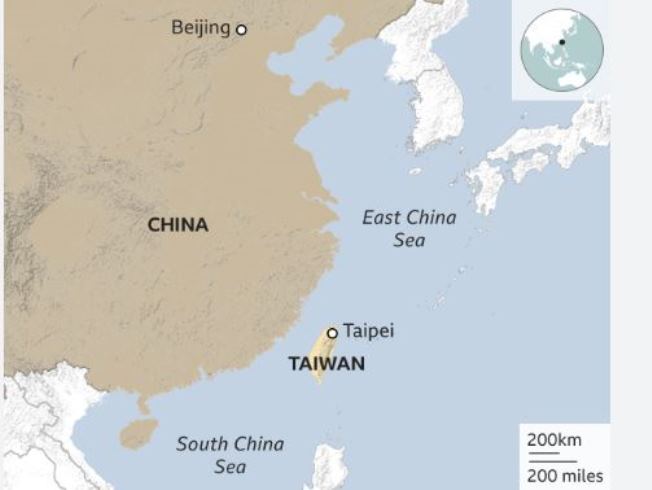
Eurasianet reported on September 8 that Chinese authorities are mobilizing support of Central Asia’s nations on Taiwan issue.
Uzbekistan is reportedly supporting China’s vision for Taiwan’s future. The government news outlet Dunyo on September 4 published a brief Uzbek Foreign Ministry statement that endorses Beijing’s “One China” policy and expresses “hope for a speedy reduction of tension.”
Eurasianet notes that China was Uzbekistan’s top foreign investor during the first half of 2023 in terms of the volume of foreign investment and loans disbursed, according to the Uzbek State Agency for Statistics. China’s share of foreign investment stood at 20.5 percent of the overall total of US$4.9 billion-worth of foreign investment that flowed into Uzbekistan during the period.
Beijing has reportedly opened two new freight rail routes to Uzbekistan as part of an effort to expand Europe-bound export route options. One of the new routes, launched on August 29, connects Zhangjiakou, an industrial hub in Hebei Province about 100 miles northeast of Beijing, with Tashkent, via the Khorgos land port in China’s westernmost Xinjiang Province. The other route, inaugurated on August 30, connects Tashkent and Liuzhou, a southern city and auto manufacturing center. "The successful launch of the Liuzhou-Tashkent train marks an increase in the number of routes from Guangxi to Europe and Central Asia to six," according to a report published by the People's Daily.
Kazakhstan’s Minister of Science and Higher Education, Sayasat Nurbek, has reportedly revealed that “about 250 bilateral agreements” are currently operating between educational institutions in China and Kazakhstan. “Now, about 3,500 Kazakhstanis study at PRC universities, and over 1,000 Chinese receive education at Kazakhstani universities," Nurbek told attendees at a conference in Astana on August 31, according to Eurasianet. He reportedly also announced that a Luban Workshop will open at East Kazakhstan Technical University. Under the program, Chinese experts will provide vocational training on the assembly of electric vehicles. China operates dozens of Luban workshops around the world, most of them affiliated with local educational institutions. The soft-power initiative provides training for workers who can then find jobs in Chinese-sponsored investment projects.
Tajikistan is also supporting China’s vision for Taiwan’s future. Tajikistan’s Foreign Ministry stated on August 4 last year that “Tajikistan supports the territorial integrity of China, in accordance with the generally recognized norms and principles of international law.” “The position of Tajikistan on Taiwan remains unchanged, we are committed to the "one China" policy, and our position is set out in all official fundamental Tajik-Chinese documents, recognizing the Government of the People's Republic of China as the only legitimate government representing all of China,” the ministry stated.


Over 600 Tajik students expelled from Russian universities – Tajikistan’s Ministry of Education
Tajikistan's Ministry of Energy names major electricity debtors
Another clash on the Tajik-Afghan border: three Afghan smugglers
9,000 Tajik children return from Russia after struggling to access education
WHO assesses Nipah virus spread risk as low, no travel restrictions recommended
Tajikistan reportedly resolves teacher shortage, education ministry reports significant increase in educators
Tehran calls IRGC a ‘counterterror’ force as EU labels it a terrorist organization
Tajikistan’s education budget to increase to 14 billion somonis in 2026
Tajikistan’s minister of agriculture criticizes meat price speculators
Solar panels being installed in Dushanbe: a step towards energy savings and a sustainable future
All news
Авторизуйтесь, пожалуйста