





The founder of zypl.ai, Azizjon Azimi, told Asia-Plus how, in 2018, despite attractive offers from global tech giants, he chose to return to Tajikistan and invest in the development of artificial intelligence (AI).
In 2018, Azizjon Azimi was studying for an MBA at Stanford, and it was a completely different time — almost like another era. He was finishing his first year, and recruitment processes were in full swing: major global companies such as Meta (then still Facebook), Amazon, Snapchat, and others were actively looking for young professionals.
“There were many events on campus every week,” Azimi recalls. “And at that point, I faced a choice: continue my career with such giants or take a different path.”
A summer return to Tajikistan in 2019 for two months became a turning point. During this time, he actively worked on developing TajRupt, a non-profit organization promoting critical thinking through education among youth.
At the time, AI was not as popular as it is now. “It was still a niche field in the tech world,” he recalls.
It was then that Azizjon made an important decision: to return to his homeland and develop an AI Academy, believing that training young professionals in this area could lay the foundation for building a strong tech industry in Tajikistan.
The challenges and obstacles faced by Azimi’s startup
In August–September 2020, Azizjon returned to Tajikistan after 12 years in the U.S. At that time, he and his team only had the AI Academy, where the first students were studying.
A key question for Azimi became how to help graduates find employment. They decided to send them for internships in financial institutions.
This led to the idea of training AI specialists specifically for the financial sector, so they could help banks adapt to new conditions.
Early challenges and market unreadiness
When Azizjon fully returned to Tajikistan at the end of 2020, the team began running pilot tests for banks. They showed that even basic machine learning models could improve forecasting accuracy and reduce default rates.
But the banks’ reaction was lukewarm.
This was a signal: if banks weren’t ready to hire the students, they needed to create a product themselves. This gave birth to the idea of zypl.ai — solving real banking problems while simultaneously creating jobs for graduates.
Building a team was difficult because there were almost no AI specialists in Tajikistan. Many who studied abroad stayed abroad.
So they began investing in the development of their own academy. The academy selected students based on actual market needs. Gradually, it expanded — now there are branches not only in Dushanbe, but also in Khujand, with others opening soon in different regions.

Growth strategy
Azizjon and his team realized the Tajik market was too small for significant growth. They began testing hypotheses, running pilots, identifying what worked, and scaling it beyond the country.
By the end of 2023 and early 2024, zypl.ai had entered new markets: the UAE, Saudi Arabia, and other countries. There, the company faced much stronger competition and stricter banking requirements, which served as a powerful growth driver.
“We started investing in specialists much more aggressively. For example, our VP of Product, Shuhrat Kholbekov, had a long and successful career in Russia, and when we began to expand, it was important to bring in talents like him,” Azimi shares.
The team also brought on Sergey Shulgin, who now heads R&D (research and development) at zypl.ai. In one year, Sergey established an R&D process and created zypl.ai’s own synthetic data generator.
“The ideal development path is to find highly qualified specialists, especially in AI. In Tajikistan and Central Asia, this isn’t easy, but the path should be: pilot early products, generate initial revenue, grow, attract venture capital, and then use those resources to bring in top talent,” Azimi emphasizes.
According to him, this is key to breaking the stereotypes that exist in society: “We should be proud that, for example, specialists from Russia — professors and PhDs — are relocating to Dushanbe to work on AI development. This helps break stereotypes and the historical trajectory of the past 10–15 years,” he adds.
The values and mission of zypl.ai
Azizjon Azimi explains that zypl.ai is a company focused primarily on R&D. Unlike companies that concentrate solely on products or services, zypl.ai builds its work around scientific research and experimental development, making it unique on a global scale.

The company is based on the concept of “black swans” described by Nassim Taleb in his books The Black Swan and Antifragile: Things that Gain from Disorder. Black swans are rare and unpredictable events that have a massive impact on the world, though people later treat them as if they were obvious.
zypl.ai accounts for these “smart outliers” in its AI models, unlike traditional approaches that exclude them from datasets.
The company has also developed a synthetic data generator that analyzes historical databases and detects missing patterns that could be crucial for forecasting accuracy.
AI is changing Tajikistan’s place on the global scientific map
Azizjon Azimi is confident that the key distinction of Tajikistan compared to its regional peers is its focus on scientific research and experimental development (R&D).
According to him, zypl.ai and Tajikistan as a whole have already built a full ecosystem of development using cutting-edge technologies.
“We are creating multimodal foundation models — architectures that work simultaneously with various types of data: computer vision, natural language processing (NLP), machine learning, and deep learning,” Azimi says.
In his opinion, this is Tajikistan’s and zypl.ai’s competitive advantage across the entire Asian region. “That’s why I’m confident Tajikistan’s position in the scientific sphere, especially in AI, will only continue to strengthen,” Azimi concludes.
Why did zypl.ai move its headquarters to Dubai?
In 2023, zypl.ai actively expanded across Central Asia, successfully launching and implementing several AI-driven projects in Uzbekistan, Kazakhstan, and Kyrgyzstan. However, a strategic question arose: where to go next and where to locate the company’s global headquarters. The choice fell on Dubai.
“Dubai’s advantage is that it has become a unique place where investors from around the world can not only coexist but work together. Today, Dubai is probably the only city in the world where investors from the U.S., China, and Russia can not only coexist but also collaborate. It’s a unique space where the interests of completely different countries intersect, and that makes the city truly special,” Azimi emphasizes.
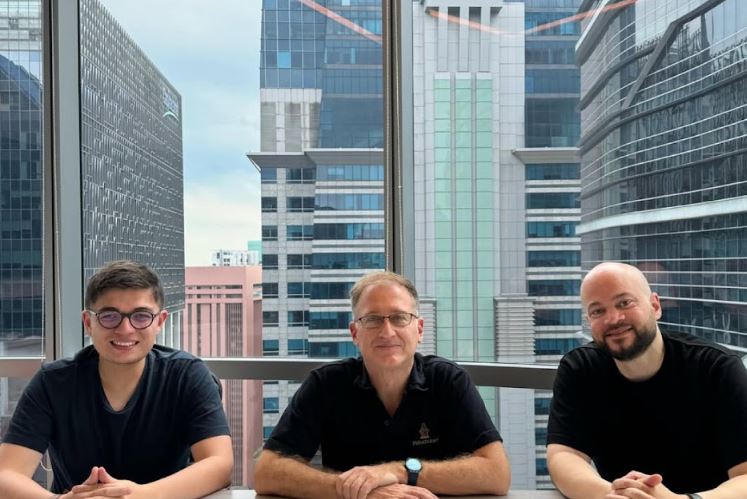
One of the key factors influencing zypl.ai’s decision to move its HQ to Dubai was the presence of the Dubai International Financial Centre (DIFC). This center has brought together investors from North America, Europe, China, and the Persian Gulf region, creating a powerful financial ecosystem beneficial to tech startups.
Practical advantages also played a role — such as convenient logistics and accessibility.
Azimi notes that being in Dubai allows him to travel the world with maximum mobility.
 Руcский
