





At the annual meeting of the Asian Development Bank’s (ADB) held in Milan in early May, a session was dedicated to discussing the role of artificial intelligence (AI) in agriculture and food security, as well as its impact on the future of food supply chains. Asia-Plus’s reporter attended the event.
Each year, technology is becoming increasingly important in agriculture. It is expected that by 2050, the global population will reach 10 billion people, placing additional pressure on food systems. Therefore, the effective use of AI is one of the most pressing issues today.
Helping farmers: a story from Brazil
Mr. Jeff Rowe, CEO of Syngenta Group, shared how AI is already transforming agriculture worldwide—from developing new crop varieties to supporting individual farmers affected by climate change. He shared a real-life example from Brazil:
“About a year and a half ago, I visited a farmer who showed me photos of soybean crops surrounded by dried-up ponds. It was just before harvest, and the farmers couldn’t do anything about it. They had invested the entire year—and lost everything.”
To help, the Syngenta team used machine learning to analyze tens of thousands of fields and images, identify the type of damage, and select a solution from existing options. What would have taken years in the past was reportedly accomplished in just a few months. This changed the lives of farmers on the ground.
AI also plays a key role in developing new crop varieties.
“Previously, breeding a new variety would take about five years. Today, we do it much faster—new varieties and packaging are reaching the market sooner, including drought-resistant crops,” noted Jeff Rowe.
According to him, in extreme weather conditions, this gives farmers greater confidence in their harvests.
Looking ahead, Rowe highlighted several other areas where AI is already being used. One of them is logistics—specifically, shortening development times and optimizing the global supply chain. AI is also significantly helping in soil analysis.

What about Central Asia?
One specific example of AI use in agriculture in Central Asia was shared by Ms. Yasmin Siddiqi, ADB Director for Agriculture, Food, Nature, and Rural Development. She explained how technology is helping in environmental protection, particularly the preservation of rare bird species.
Along migratory routes of birds—including endangered species like bustards—wind turbines are being built. These birds are critically endangered, and collisions with turbines are fatal. However, AI can identify what kind of bird is approaching from kilometers away and automatically shut down the turbine.
“This is a great example of how technology can benefit both nature and development,” Yasmin Siddiqi said.
This example demonstrates how AI can not only aid agricultural development but also address key environmental concerns, combining technological advancement with sustainable development.
Inclusiveness in agriculture
During the session, Yasmin emphasized the importance of recognizing that women make up a significant portion of the agricultural workforce. In Central Asian countries and other developing regions, women often bear the brunt of farm labor, yet are frequently overlooked in terms of access to support and technology.
“My first point is this: farmers are women too,” Yasmin declared.
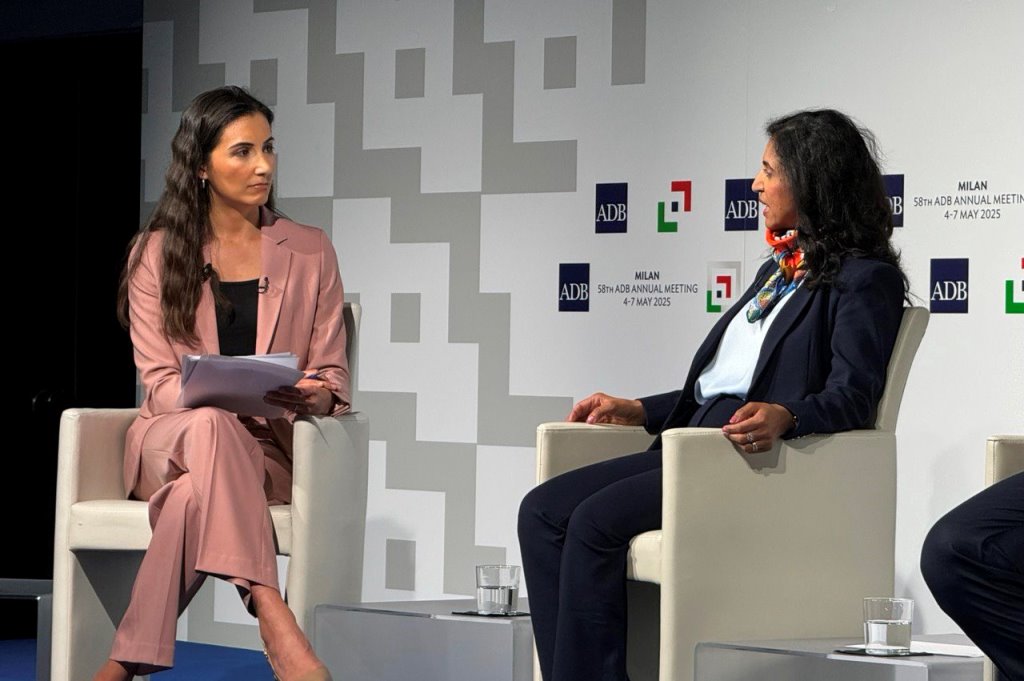
However, as she noted, not all women have the same access to resources as men. “That’s why we need to be inclusive—to think about the women who make up the majority of farming communities in our countries. Not all of them are literate. Not all of them have access to mobile phones, as in some countries, women are less likely to own phones compared to male farmers. This is a critical issue,” Yasmin Siddiqi emphasized.
She cited the example of a farmer from Tajikistan, Malika, whose image she described as symbolic of those the ADB seeks to support.
“In Tajikistan, I met a farmer named Malika. She wakes up early, first feeds her children, then goes to the fields, tends to them, returns home for lunch, feeds her children again, and returns to the fields—even in the heat. To me, this is ‘my farmer,’ and these are the kinds of farmers I strive to support through the ADB,” Yasmin shared.
Ultimately, the ADB aims to create sustainable food systems that meet both environmental needs and the interests of farmers and their communities. It is vital that new technologies like AI are accessible to everyone and contribute to building a fairer future for rural areas.
 Руcский