




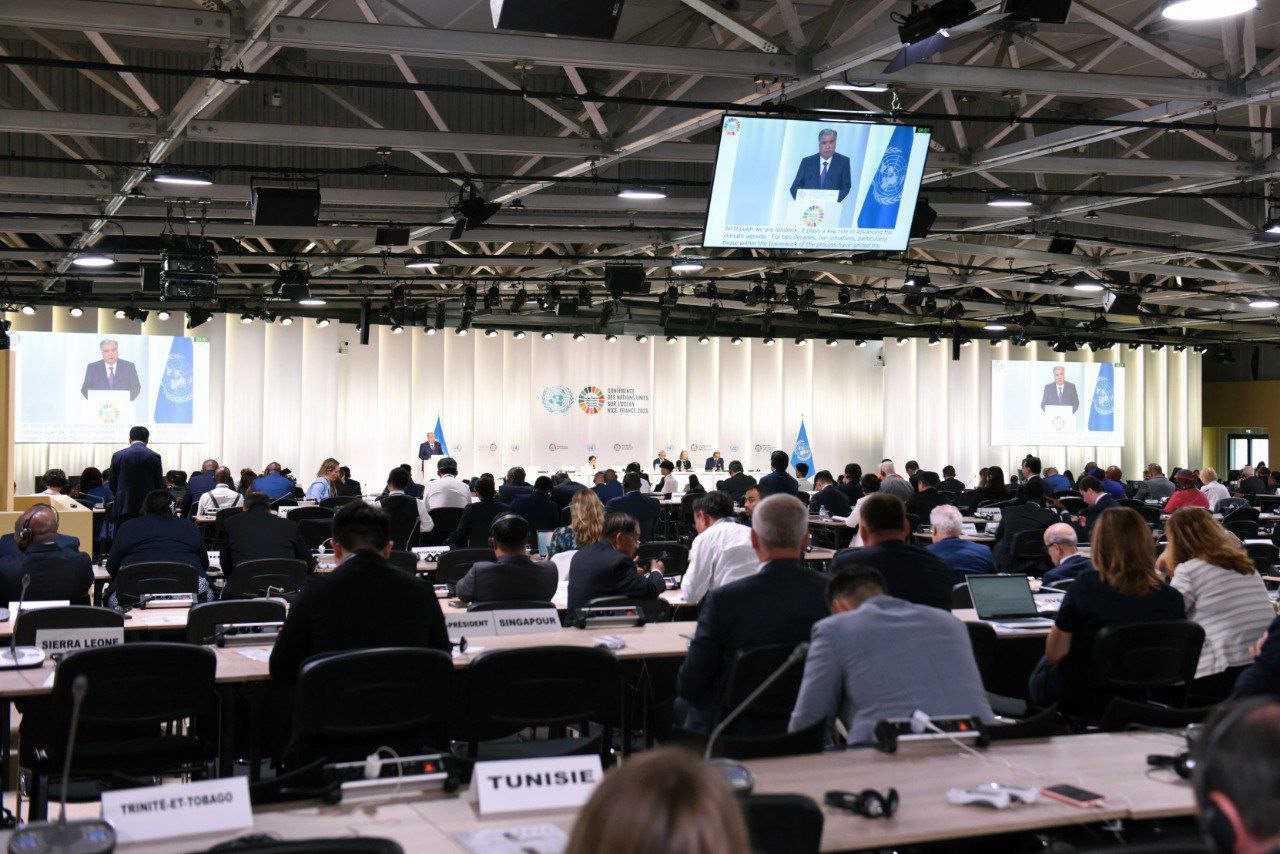
Tajik President Emomali Rahmon called for collective international action to protect the world's oceans during his address at the United Nations Ocean Conference held in Nice, France, yesterday.
The Tajik president’s official website says the conference, which saw participation from over 15,000 delegates across 120 countries, brought together leaders, experts, and representatives from more than 70 international and regional organizations.
Rahmon’s statement highlighted the urgent need to address modern threats to the oceans, emphasizing that these challenges have become a global issue requiring joint efforts from all nations.
Rahmon stressed that the preservation of oceans, which cover more than 70% of the planet’s surface, has risen to the forefront of global priorities. “The modern threats to our oceans are a collective problem, and now, more than ever, we must take unified action to safeguard this vital resource,” the Tajik leader said.
Although Tajikistan is a landlocked country, Rahmon underscored the nation's active role in advancing global water and climate agendas. He referenced the “Dushanbe Water Process,” a long-standing initiative led by Tajikistan, which has brought together UN member states, international organizations, and other stakeholders for nearly two decades to address pressing water issues.
In his address, Rahmon also linked the challenges facing oceans with another pressing environmental concern: the rapid melting of glaciers. He pointed out that glaciers, essential sources of fresh water, play a crucial role in maintaining the global ecosystem. “The rapid depletion of glaciers, combined with the growing demand for water, has raised deep concern within the international community,” he said.
To further highlight the issue, Rahmon reminded attendees that March 21 is now observed as “World Glacier Day” by UN resolution, and Tajikistan recently hosted the first International Conference on Glacier Preservation in late May. The conference became a significant platform for discussing collaborative measures to mitigate glacier loss.
Rahmon concluded by reiterating that the conservation of oceans, water resources, and glaciers is a shared responsibility among all nations. He proposed an increase in global funding and investment to protect marine ecosystems and fresh water sources, calling for enhanced international cooperation to achieve these goals.
“The event in Nice sets the stage for new global commitments and actions that will protect both our oceans and the future of underwater life,” Rahmon said, expressing hope that the conference would pave the way for more substantial, unified efforts.
 Руcский
