




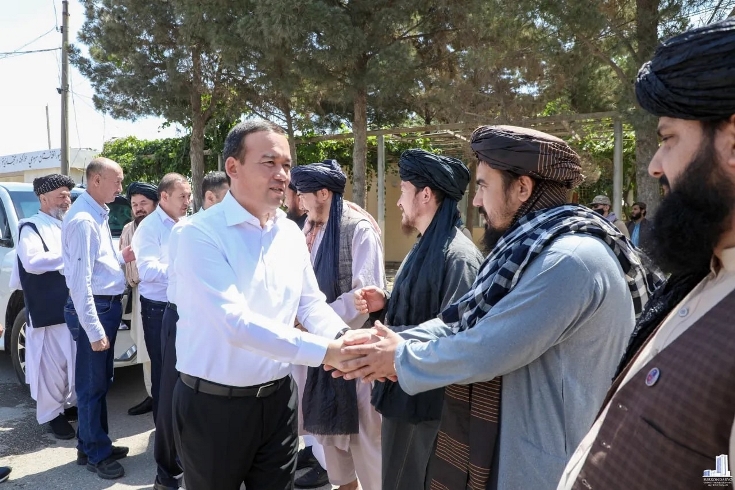
Eurasianet reports that relations between the five Central Asian countries and Afghanistan are warming as plans move ahead for new rail links, increased trade and creating opportunities for ordinary Afghans.
The Central Asian nations are reportedly prioritizing bringing Afghanistan back into the economic fold with increased connectivity and trade focused on practical cooperation that serves their economic interests and, ultimately, helps improve regional security, analysts say.
“We try to look on Afghanistan more pragmatically because if we build a wall around Afghanistan, then it is not useful or helpful for the regional situation, stability and security. That’s why we are involved in economic ties,” Sanat Kushkumbayev, chief research fellow at the Kazakhstan Institute for Strategic Studies, a think-tank close to the government, told Eurasianet in an interview.
A regional forum, which held in Mongolia’s capital, Ulaanbaatar, last month, discussed promoting closer collaboration between Central Asia, Mongolia, the Caucasus and Afghanistan (CAMCA).
Central Asian efforts to strengthen connections with Afghanistan reportedly received a boost on July 3, when Russia officially recognized the Taliban government in Kabul. Russian recognition potentially paves the way for Central Asian states to follow suit in the not-too-distant future.
Experts note that tighter ties will be a win-win for all parties.
Trade between Central Asia and Afghanistan is on the rise. According to Eurasianet, Uzbekistan-Afghanistan bilateral trade last year valued at US$1.1 billion, around 25 percent up on 2023.
Taliban officials have reportedly become increasingly visible at regional events, signaling that Afghanistan is open for business.
While the Central Asian governments pay lip service to the need to improve the lot of women and minorities in Afghanistan, they do not publicly take the Taliban to task over human rights, preferring to focus on mutually beneficial cooperation.
One important area of engagement is forging new transport routes linking Central Asia with the wider world through Afghanistan. The war in Ukraine is forcing Central Asian governments to seek alternatives to the well-established northern corridor via Russia and look for access to new markets and export routes.
Eurasianet reports that the Central Asian nations are prisoners of their geography: all are landlocked and must go through a second country to reach an ocean; Uzbekistan is double landlocked and needs to go through two countries.
Uzbekistan is promoting a trans-Afghan Corridor that would connect it with Pakistan’s Arabian Sea ports via Afghanistan, if completed. One proposed rail route would connect Termez on Uzbekistan’s Afghan border with Peshawar in Pakistan via Kabul.
Uzbekistan already hosts a transport and logistics hub on the border, the TermezCargo Center, aimed at streamlining the transportation of rail and road cargo into and out of Afghanistan.
An Uzbek-built railroad has connected the northern Afghan cities of Hairatan and Mazar-e Sharif since 2011. This is the main gateway for Afghanistan’s imports from Central Asia, connecting with Uzbekistan’s rail network in Termez via the Friendship Bridge, a Soviet-era structure crossing the Amu Darya river.
In February, it was announced that work would start on extending the line to Herat on Afghanistan’s border with Iran, after completion of a feasibility study. This could ultimately provide access to the Persian Gulf for double landlocked Uzbekistan.
Kazakhstan and Turkmenistan are collaborating on another rail link crossing Afghanistan, for which Astana allocated US$500 million in April. The route starts in Torghundi, on Afghanistan’s border with Turkmenistan, and passes through Herat and Kandahar on its way to Spin Boldak on the border with Pakistan – again providing access to maritime trade, and the huge markets of South Asia, for the landlocked Central Asian states.
However, the volatile security situation in Afghanistan may well impact the implementation of these projects.
Beyond diversifying transport and export routes, there is a focus on providing ordinary Afghans with jobs with the aim of economically stabilizing the war-ravaged country. Kazakhstan, Kyrgyzstan and Uzbekistan offer scholarships to Afghan women to pursue studies under a European Union-funded scheme which began before the Taliban came to power, but has become a lifeline now that women are barred from attending university at home.
Another project designed to draw Afghans closer to Central Asia is the AIRITOMFree Zone in Termez, which opened last year and allows Afghan citizens to enter for up to 15 days visa free. This 35-hectare zone offers access to shopping, leisure, healthcare and educational facilities in a secure setting.
Meanwhile, relations between Tajikistan and the Taliban are slowly thawing, but chill still remains. Official Dushanbe is maintaining a delicate balance with the Taliban. On one side, the Tajik authorities are developing economic links with Afghanistan, none more important than the electricity deals that have seen Tajikistan export increasing amounts of power southward in recent years. On the other side, rest political considerations. Tajik officials still style Dushanbe as the defender of the interests of ethnically Tajik Afghans, who comprise roughly a quarter of Afghanistan’s population.

6 top innovative startups in Tajikistan in 2025
Tajikistan’s CBRN Safety Agency and Border Troops agree to improve methods for detecting CBRN threats
A 19-yer-old man arrested on suspicion of corrupting a 14-year-old girl
Tajikistan’s fruit production surpasses expectations
The growing threat of teen aggression: how to prevent it?
Terrorists who attacked Tajik border guards were members of Jamaat Ansarullah, reports Afghan media
China’s investment expansion in Central Asia: what it means for the region
Tajik national arrested in Russia after comments on killing of 10-year-old Qobiljon Aliyev
Pope Leo XIV calls for peace in Middle East, Ukraine in first Christmas message as pontiff
Tajikistan among top three tourist sources for Uzbekistan
All news
Авторизуйтесь, пожалуйста