





Today, mines and unexploded ordnance continue to remain an acute problem posing threat to people’s security across many countries. Along with jeopardizing human life, the mines seriously challenge socioeconomic development, damage the environment and cultural heritage, hinder post-war recovery and development initiatives, and ultimately impede the Sustainable Development Goals, even decades after wars have ended.
The Republic of Azerbaijan faces a significant challenge due to landmine and explosive remnants of war (ERW) contamination.
While mine explosions pose a threat to people’s lives and put their very right to live into question, they also significantly damage the environment. Plastic waste resulting from an explosion entails environmental consequences by negatively impacting soil structure. Mines that remain unearthed for a long time can lead to hazardous chemical reactions. The soil not in use due to threat of mines is subjected to erosion and abrasion.
Azerbaijan is among the most heavily mine-contaminated countries globally. The latest survey indicates that total contaminated area in the liberated territories of Azerbaijan stands at approximately 11,667 square kilometres. This area constitutes more than 13.4% of the country's total territory of 86,600 square kilometres. More than 1 million landmines and unknown number of ERW contamination in these territories pose severe risks to civilians and hinder socio-economic development.
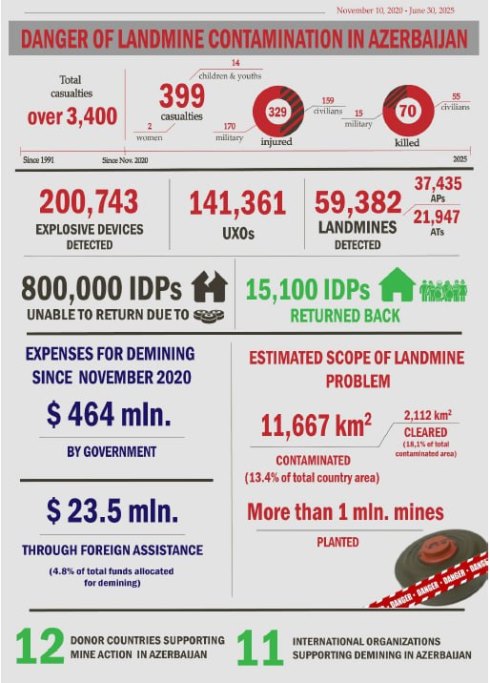
From 8 November 2020 until 30 July 2025, 243 landmine explosion incidents occurred, resulting in 400 victims, including children and women, underscoring the urgent need for mine clearance and victim assistance. Over the last 30 years, the cumulative toll of landmine victims in Azerbaijan has exceeded 3,400.
The end of war in 2020 marked the beginning of an extensive humanitarian demining in Azerbaijan to restore safety in the liberated territories, facilitating the reconstruction of these areas and the safe return of former internally displaced persons (IDPs). Foreign assistance has accounted for only 4.8% of the resources dedicated to demining. This is notably low, both in light of the gravity of demining challenges Azerbaijan confronts and when compared to the level of contributions typically made by the international donor community to similar issues elsewhere.
Refusing to present to Azerbaijan accurate maps of landmines it planted in the Azerbaijani territory complicates the demining efforts and obstructs return of former 800,000 IDPs to their homes.
Given the immense adverse humanitarian impact, and the fact that lingering landmine contamination represents a challenge to efforts to achieve peace and reconciliation, Azerbaijan counts on adequate political and practical support by the international community to its demining efforts as a matter of human solidarity.
As part of the “Great Return” program to liberated territories of the Republic of Azerbaijan, identified as one of the main strategic goals in the National Priorities for Socio-Economic Development: Azerbaijan 2030, ANAMA is conducting large-scale mine clearance activities in accordance with International Mine Action Standards (IMAS). The clearance operations, primarily in areas designated for residential infrastructure, agriculture, transportation, energy, industrial parks, and other priority sectors, are carried out with the support of manual deminers, specialized mechanical equipment, mine detection dogs, and rats. International non-governmental organizations (NGO’s), such as MAG and APOPO, also contribute to the mine clearance efforts. Additionally, relevant state institutions, local companies, and NGO’s are actively involved in the process.
The Government of Azerbaijan provides assistance for the care and rehabilitation, social and economic reintegration of mine victims and for mine risk education programs. Assistance is provided to meet the immediate and long-term needs of EO survivors, their families and persons with disabilities. Assistance includes, but is not limited to, emergency and continuing medical care; physical rehabilitation; psychosocial support and social inclusion; and laws and public policies that promote effective treatment, care and protection for all disabled citizens.
Azerbaijan sides would appreciate practical assistance for demining efforts of Azerbaijan. Given Azerbaijan's relatively developed institutional capacity and training frameworks, the most critical form of assistance needed at this juncture is direct financial donations to amplify the scope of operations.
Other priorities include mine victim assistance (as well as providing prostheses); technical surveys and feasibility studies; support for female demining teams, data management and technological advancements; implementing geo-spatial methodologies and technology layering to refine clearance needs; mechanical demining enhancement; mine detection dogs training; demarcation and fencing; and explosive ordnance risk education.

Happy New Year, friends!
The horse spirit of Tajikistan: from ancient bloodlines to modern champions
International education in Central Asia: how UCA opens the door to a global career
EcoCars: how a company with Tajik roots became one of China’s first official EV exporters
Barqi Tojik promises uninterrupted power supply during New Year holidays
Emomali Rahmon extends New Year greetings to the people of Tajikistan
Sharif Nazarov, a pillar of Tajik football, passes away at 79
Winter Recreation in Tajikistan: where to recharge and enjoy nature
Three-year-old child dies after beating in Fayzobod district; stepmother suspected
Tajikistan expands list of officials required to declare assets and income
All news
Авторизуйтесь, пожалуйста