




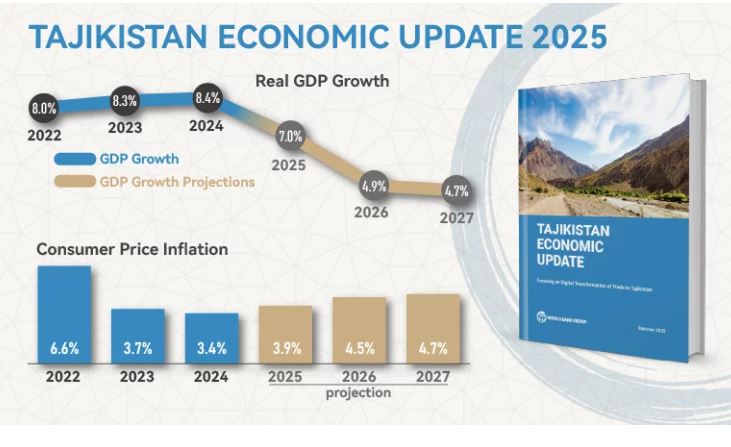
Tajikistan’s real gross domestic product (GDP) growth reached 8.4 percent in 2024 and 8.2 percent in the first quarter of 2025 with services and industry driving the expansion, according to the World Bank’s Tajikistan Economic Update: Focusing on Digital Transformation of Trade in Tajikistan released on July 30.
Domestic demand was bolstered by substantial remittance inflows, which totaled approximately 49 percent of GDP in 2024 compared to 39 percent in 2023, and by increased public sector wages.
The medium-term outlook remains favorable, with growth projected to moderate to 7.0 percent in 2025 and converge toward a growth rate of 4.5-5.0 percent in 2026–27. This trajectory reflects the anticipated normalization of remittance inflows, ongoing global trade-related uncertainties that could disrupt supply chains, and a weaker demand for metals and minerals except for gold.
Sustaining Tajikistan’s strong economic momentum and unlocking its growth potential will depend on the government’s firm commitment to accelerating actions aimed at attracting greater private investment, such as by strengthening the competition framework, streamlining investment procedures and enhancing investor protection rights, and promoting public sector efficiency and accountability for better public service delivery.
The country could also benefit significantly from a digital transformation of its trade sector, the report says, identifying significant infrastructure and regulatory gaps. Poor internet connectivity affects nearly half of customs checkpoints, and there are deficiencies in digital identity, paperless trade, data protection, security standards, cross border data transfers, and consumer safeguards.
The report highlights several priority domains to accelerate digitalization in Tajikistan, including enhancing digital connectivity and cybersecurity, modernizing government digital services for more efficient online public services, creating an integrated ecosystem to facilitate seamless trade operations, and implementing performance monitoring. It also emphasizes strengthening legal foundations to align with international standards for electronic transactions and data protection and establishing trust mechanisms with robust consumer protection and cybersecurity protocols. Additionally, developing institutional expertise is crucial for building capacity within the government and trading community.
The World Bank is one of the world’s largest sources of funding and knowledge for developing countries. It is committed to reducing poverty, increasing shared prosperity, and promoting sustainable development. The World Bank is currently financing 26 projects in Tajikistan, totaling $1.9 billion.

6 top innovative startups in Tajikistan in 2025
Tajikistan’s CBRN Safety Agency and Border Troops agree to improve methods for detecting CBRN threats
A 19-yer-old man arrested on suspicion of corrupting a 14-year-old girl
Tajikistan’s fruit production surpasses expectations
The growing threat of teen aggression: how to prevent it?
Terrorists who attacked Tajik border guards were members of Jamaat Ansarullah, reports Afghan media
China’s investment expansion in Central Asia: what it means for the region
Tajik national arrested in Russia after comments on killing of 10-year-old Qobiljon Aliyev
Pope Leo XIV calls for peace in Middle East, Ukraine in first Christmas message as pontiff
Tajikistan among top three tourist sources for Uzbekistan
All news
Авторизуйтесь, пожалуйста